
Occular Cryosurgery
Freezing tumours off eyeballs (and surrounds)
By our Vet Hannah Biddulph
You may have come across our vets using this technology on farm. If not, here is a little introduction into use of cryosurgery (“freeze” surgery).
Cryosurgery uses extreme cold temperatures to destroy cells. You might be familiar with this process used on human warts. In the vet world, we often use this technique to remove tumours that cannot be cut out completely with surgery.
As you are likely aware, cattle can get tumours or growths on their eyes, often called “cancer eye.” Depending on the exact location and the impact on the surrounding structures, surgery may or may not be advised. If the tumour is on the eyeball itself there is only so much cutting out we can achieve, so we can use cryosurgery instead.
Unlike thick callused skin on the hands, eyeballs are extremely sensitive so local anaesthesia (numbing) of the area is necessary. Another challenge is that unlike humans, we can’t just politely ask the cows to point their eyes in the direction we need them to.
Firstly we often use an anaesthetic block that relaxes the eyeball muscles and stops vision temporarily. This allows us to pop the eyeball out of its socket for better access to the tumour. It also helps that the cow can no longer see out of this eye and can’t use its eyeball muscles to move away from our gloves in her face. At this point more local is applied, and if necessary we cut the bulk off the mass with a scalpel.
Now the delicate part. There are likely still cancer cells remaining on the base of where the mass was, but we can’t cut the eyeball open. This is where we use cryosurgery to destroy these cells. We are lucky enough at RVC to have access to a special gun that applies liquid nitrogen (-200° C) to destroy the last cancer cells remaining.
When do we choose to use cryosurgery and what are the chances of success?
Often we opt to use cryosurgery when there are tumours on the eyeball itself. The other surgical option would be removing the entire eye, but if possible we would like to save the eye. Another application is to destroy the base of a tumour where we cannot completely surgically remove the tumour (often around the eyes, but they can be anywhere on the body). Compared to conventional surgery, it is harder to judge whether we have removed the entire tumour after cryosurgery, so there is always more uncertainty. The benefit is that we can save body parts or animals that otherwise do not have another option.
For eyeball tumours, we can get an idea of success with how deep the tumour runs in the eyeball. The cornea (clear layer) of the eye becomes cloudy with tissue disruption, so cloudiness around the tumour might indicate a deeper tumour that may have less chance of complete cure with cryosurgery.
Now’s the time to look away if eyes make you queasy!
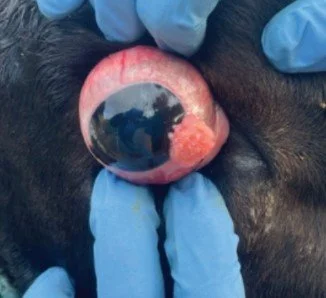
Step 1: Local Anaesthetic and expose the eyeball
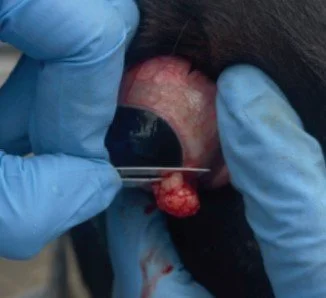
Step 2: Remove most of the tumour with a scalpel blade
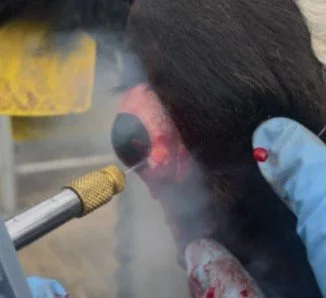
Step 3: Cryosurgery destroys the remaining tumour cells
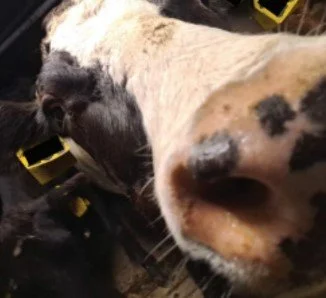
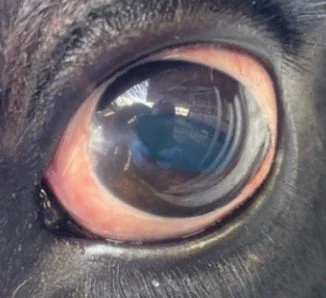
Happy cow 4 weeks later
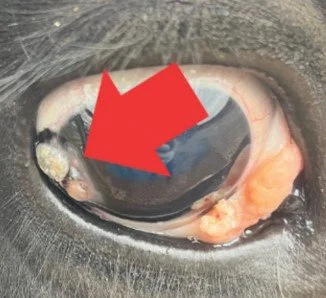
Case A: Before surgery. Note a cloudy margin around the tumour
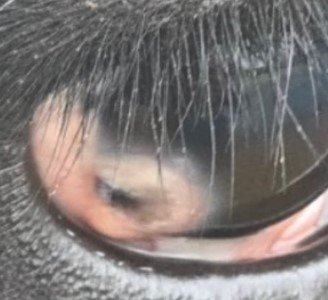
Case A: After 6 weeks and 2 cryosurgery treatments. Cure not achieved
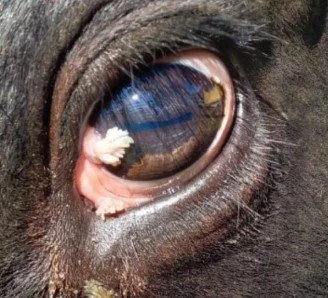
Case B: Before surgery. No cloudy margin around tumour
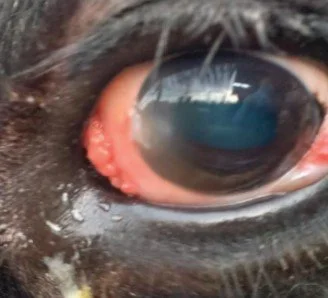
Case B: 2 weeks after cryosurgery
Case B: 4 weeks after cryosurgery. Cured